Audit readiness & reporting systems for federally funded programs
The Rural Health Transformation (RHT) Program — the federal initiative funneling rural-health dollars through your state to the clinics and community programs that need them — only works once the reporting behind it does. Year-1 obligation deadlines arrive fast, and any organization that expends $1M+ in federal awards in a year owes a Single Audit under 2 CFR 200. This page is OlenArc’s interactive reference design — informed by the deployed ASCF grant-operations work — showing how a custom grant-management system turns post-award chaos into an audit-ready record — built around tribal/Native-serving and rural health subrecipients, without replacing your CPA. We build these workflows into a system scoped to your program.
At a glance
By the numbersOne place for the grant evidence and reporting workflows your program is responsible for
The reference design shows how a custom system organizes award evidence the way auditors actually ask for it — without replacing your CPA or your accounting software. Everything shown runs on fictional sample data; in an engagement, these workflows are built and scoped to your program.
Reporting calendar
Quarterly and annual due dates auto-derived from each award — with a countdown to surface upcoming deadlines.
Procurement evidence tracker
Per purchase: quotes, sole-source justification, approvals, and 2 CFR 200 Appendix II clauses.
SEFA workbook
Award → ALN → pass-through identifier → amount, with a tie-out indicator — the Schedule of Expenditures of Federal Awards, ready before fieldwork.
Evidence binder + CPA-ready export
A living, per-award binder with a “what’s still missing” list — and a one-click clean export you can hand your CPA or auditor.
Subrecipient-monitoring log
If you pass funds down, the 2 CFR 200.332 monitoring trail: updates, document requests, and risk notes in one place.
AI “what’s missing / at-risk”
An assistant that flags missing documents and drafts report narratives — it surfaces risk and saves time, but it never certifies compliance.
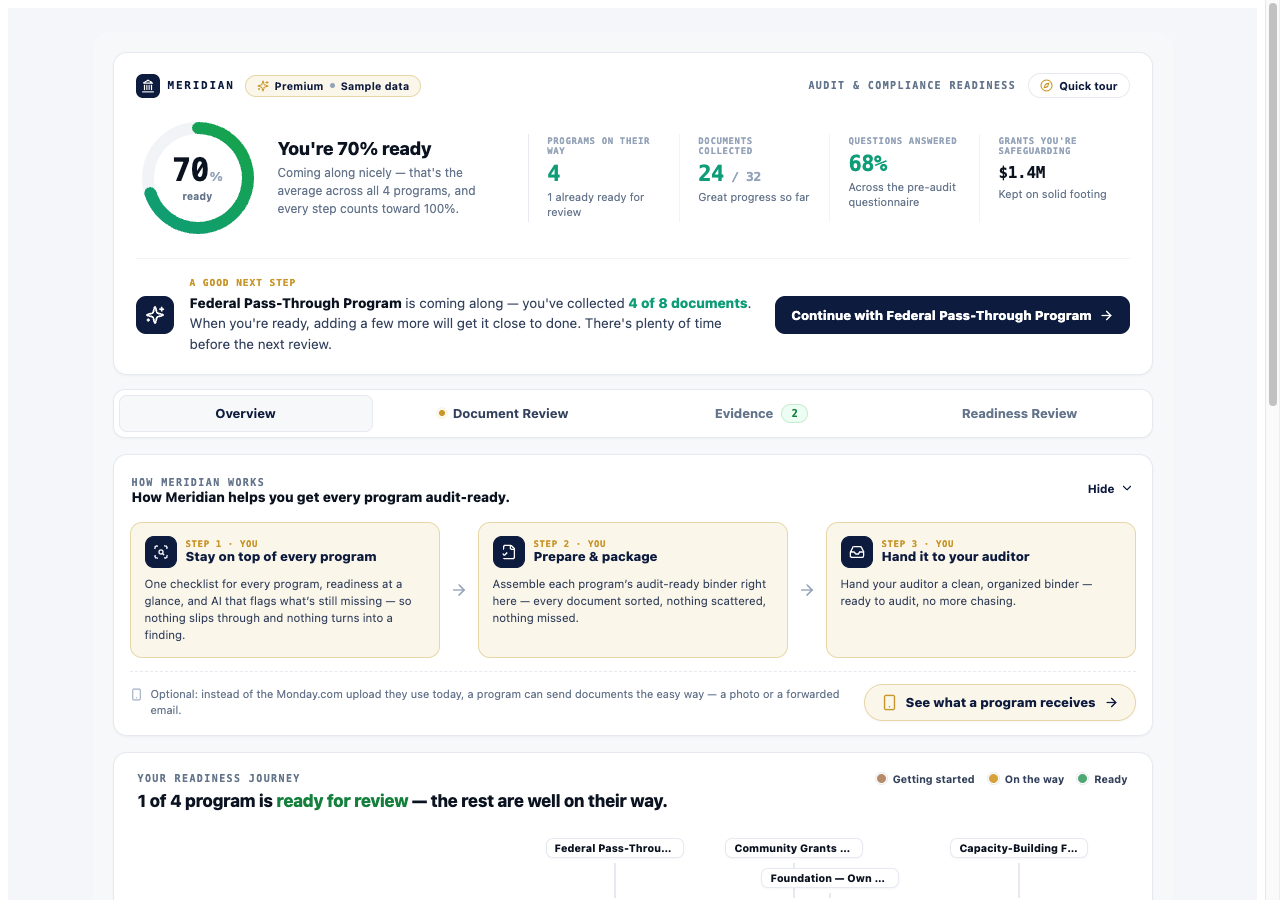
Click through the whole workspace
A working, sample-data preview of all six surfaces — dashboard, reporting calendar, procurement evidence, SEFA, evidence binder, and subrecipient monitoring — populated with realistic tribal/rural-health examples. No login.
What we do vs. what your CPA does
OlenArc organizes your evidence — it does not replace your CPA, auditor, or legal counsel. No audit opinion, no allowability determination, and no guarantee of a clean Single Audit.
We already build software for the Arctic Slope Community Foundation, an Alaska Native community foundation — an integrated grant platform across all 8 North Slope Iñupiat villages. See the case →
Where the money flows — and where we plug in
RHTP money travels a known path. We plug in at any upstream node — the state administrator, the fiscal intermediary, or the subrecipient who owes deliverables back.
How we’re shaped differently from your other options
If you’ve been quoted by the usual generalist consultancy — or you’re still running this in Excel and email — this is how a civilian software studio fits the gap.
The deployed evidence behind this design
The audit-readiness workspace shown here is an interactive reference design on fictional data, informed by OlenArc’s deployed grant-operations work with the Arctic Slope Community Foundation — an integrated grant platform for all 8 North Slope Iñupiat villages: applicant portal, admin / review dashboard, AI navigator, impact reporting. ASCF’s grant-management platform is deployed; the reference design itself is not a deployed client system.

If you’ve already won an RHTP award — let’s scope what you owe
Tell us your state, your initiative pillar(s), and your nearest reporting deadline. We come back within two business days with a scoped proposal or a straight fit / no-fit read.