A glacier and frozen lake under an Arctic sky in Alaska.
At a glance — for the 30-second skim
  • In production with ASCF — the Utqiaġvik calendar & Olen Hub are soft-launched
  • 8 of 8 North Slope Iñupiat villages served by the ASCF grant platform
  • 4 of 5 module shapes deployed — portal, intake, AI doc review, dashboard
  • Named, verifiable clients — references available under mutual NDA
  • Audit-ready — named clients with references available under mutual NDA

Why deployed work matters more than pilots

These platforms are deployed in production, named, and verifiable. For Tribal IT directors, state HHS procurement leads, and foundation program officers evaluating us as a direct vendor, these are concrete evidence of what a 4–12 week module engagement actually delivers. For federal teaming readers, they also count as commercial past-performance evidence under FY2026 NDAA Section 824; we do not claim CPARS-rated federal past performance.

  • Deployed in production — ASCF and the Utqiaġvik calendar serve real users every day.
  • Named, verifiable clients — Arctic Slope Community Foundation, City of Utqiaġvik. References available under mutual NDA.
  • Scale-relevant deployment — 8 of 8 North Slope Iñupiat villages, demonstrating multi-village rollout capability.
  • Cross-shape coverage — our deployed work spans 4 of our 5 module shapes (portal, dashboard, intake, AI-assisted document review). Integration glue is the only shape we evidence via reference design rather than production deployment.
Deployed engagements

Direct foundation and municipal engagements, in production.

Community foundation · Native-serving · Grant-funded programs

Arctic Slope Community Foundation

First integrated grant management platform deployed across all 8 North Slope Iñupiat villages.

8 villages Since 2026 Multi-year agreement 4 of 5 module shapes

Deployed: Arctic Slope Community Foundation grant management platform, serving all 8 North Slope Iñupiat villages. Modules: applicant portal, admin/review dashboard, AI-summarized impact reporting, AI navigator chatbot.

Deployed in production 8-village platform Applicant portal AI chatbot Native-serving
app.olenarc.com/grants
Grants Impacts map of North Slope communities, showing village pins with grant amounts and category-breakdown summary cards (illustrative).
 full case study
Project typeMulti-module grant program platform — applicant portal, admin / review dashboard, AI-assisted impact reporting, and applicant-facing knowledge-base chatbot
SummaryBuilt and deployed an integrated grant-management platform serving all eight North Slope Iñupiat villages. Replaces fragmented email / PDF / spreadsheet intake with a single role-based platform where applicant organizations apply online, ASCF staff review and award, and leadership tracks impact across communities. An AI navigator chatbot built on a local knowledge base answers common applicant questions, reducing intake-team load and supporting capacity-building for grant-seeking organizations.
What we built
  • Applicant portal — public-facing grant application flow with role-based logins so applying organizations can track their submissions over time
  • Admin & review dashboard — ASCF staff view for intake, review, scoring, and award decisions
  • Impact reporting layer — funding-by-community visualizations and AI-summarized program performance narratives
  • AI navigator chatbot — applicant-facing FAQ assistant built on a local knowledge base
  • Role-based data separation — applicants see only their own submissions; reviewers see all applications; leadership sees aggregate impact
Scale of deploymentDeployed in production across the entire North Slope region (eight Iñupiat villages). To our knowledge, an integrated grant-management platform of this kind for the region.
Engagement outcomeReplaces fragmented PDF / email / spreadsheet intake with a single role-based platform serving applicant organizations, ASCF staff, and leadership in one environment. Applicants apply online and track their submissions; staff review and award inside the same system; leadership sees aggregate impact across communities; the AI navigator chatbot reduces intake-team load by answering common applicant questions from a local knowledge base.
Capabilities usedPublic-facing portal development · Role-based authentication · Intake & review workflows · AI-assisted reporting · Knowledge-base chatbot · Impact visualization · Community-data design
Engagement shapeDirect foundation engagement (not federal sub). Deployed in production. Senior core, staffed to scope.
Maps to moduleThis single engagement spans four of our five module shapes: public-facing portals, intake / eligibility / workflow, AI-assisted document review (chatbot), and program & reporting dashboards. Translatable into a direct Tribal program engagement, foundation initiative, state HHS contract, or federal sub task order at IHS DGM, BIA / BIE Grants Management, or HHS sub-agency reporting — one module shape, multiple persona entry points.
ASCF Local Grants portal — applicant landing page with Start Apply call-to-action and an FAQ side panel covering eligibility, focus areas, required documents, deadlines, eligible expenses, payment, and post-award requirements.
Applicant portal — Apply for a Grant from ASCF (preview layout)

Layout shown is the public applicant-facing portal. Applicant organizations log in to apply, track their submissions, and access the knowledge-base FAQ navigator. UI and FAQ copy shown are representative; not a live capture of production data.

General Progress Report — Funding by Community bar chart and AI-drafted Charitable Activity Target Progress narrative with Priority vs Target donut and By Charitable Activity pie chart.
Admin view — AI-generated General Progress Report (illustrative)

All community names, dollar amounts, percentages, and AI-drafted narrative shown are demonstration placeholders only. They are not live data, not audited totals, and do not represent any organization's actual grant records or program performance.

City government · Community engagement

The City of Utqiaġvik

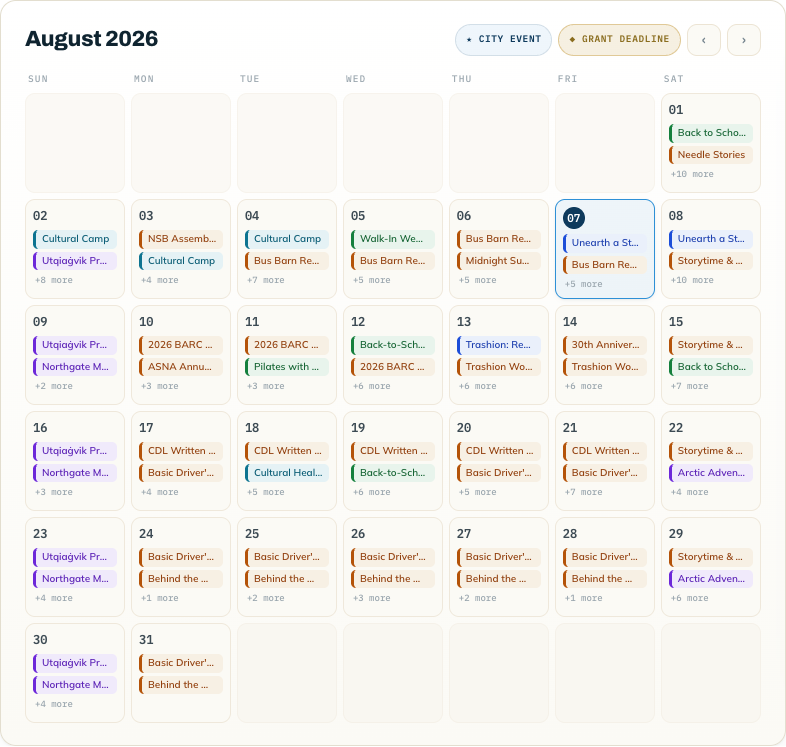
Aggregated community events from Facebook, agency pages, and informal channels into one searchable local calendar.

Northernmost US city Since 2026 12-week build Direct municipal

Deployed: City of Utqiaġvik community calendar — northernmost city in the United States, ~4,500 Iñupiat residents. Direct municipal engagement (not federal sub). Ongoing operating agreement.

12-week build · Facebook + agency-page event aggregation · AI classification layer

Direct municipal engagement Event aggregation AI classification Facebook integration
 full case study
Project typeCommunity calendar and engagement platform
What we supportedCommunity calendar platform · Event aggregation workflow · AI-assisted event categorization · Admin review process · Local event discovery experience · Potential integration into a broader resource hub
CapabilitiesPublic-facing web platform · Event aggregation · AI-assisted classification · Community engagement design · UX co-design · Local government implementation support
Engagement outcomeSingle searchable community calendar replacing manual aggregation across Facebook groups, agency pages, flyers, and informal channels. Reduces program-staff workload while improving event discoverability for residents and incoming agency partners.
Engagement shapeDirect municipal engagement (not federal sub).
Maps to moduleCommunity Calendar / Event Aggregation — translatable into a municipal engagement, Tribal community initiative, or federal sub task order at BIA / BIE, DOI, or HHS community-engagement programs.
Prototypes & pilot platforms

Pre-launch pilot platforms and internal demos we use to evidence solution shape during capture and proposal phases. Re-skinnable or pilotable for direct engagement, foundation pilot, or federal sub task order.

Tribal · Native-serving · Community services

Olen Hub

White-label community Hub combining local-knowledge chatbot, event aggregation, and cross-agency intake into one platform — 6–12 week re-deployment per host organization.

Near-deployment-ready 2026 6–12 wk re-skin White-label

Status: Olen Hub white-label community platform, pre-launch. Designed for Tribal, Native-serving, nonprofit, and local-government programs.

Pre-launch pilot AI chatbot Cross-agency intake White-label Native-serving
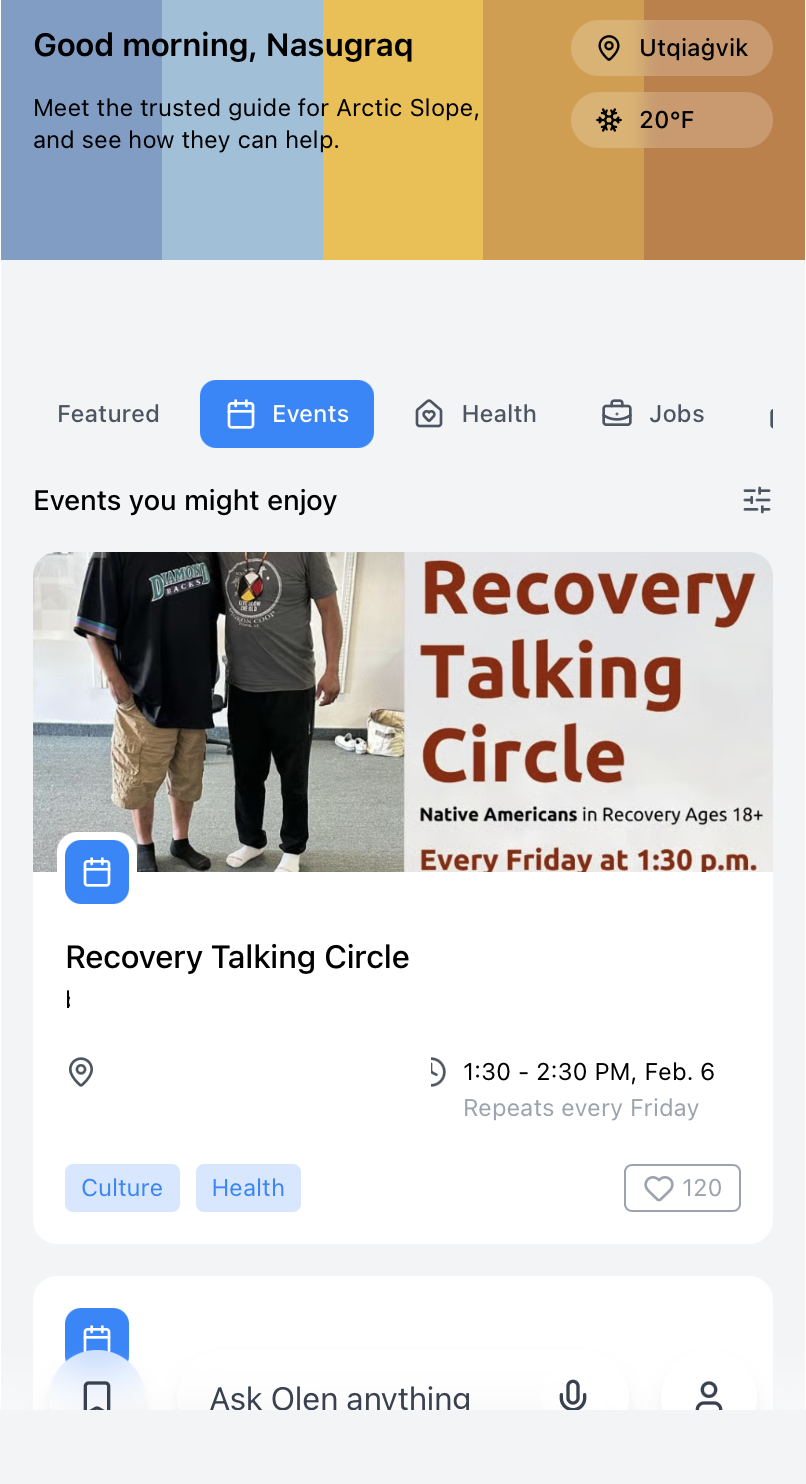
Olen Hub white-label home screen with location, weather, category tabs, and an Ask Olen anything search bar (illustrative).
Olen Hub community calendar — a month view with event markers and an events-for-the-day list below.
Live now

See the live web app — Community Calendar

The community calendar is live today — residents browse local events in one place. The chatbot, cross-agency intake, and resource hub are in active development and roll out per deployment; AI features are optional, not required.

Open the live web app →
 full case study
Olen Hub Connected Community and Administrator Ecosystem — User Hub on mobile (Events, Jobs, News, Health & Wellness, Government Services, Community Programs) feeds into Chat Service for inquiry and support, which routes to Intake Forms for structured data collection, which surfaces in the Administrator Dashboard for overall impact and outreach, with audit-ready output for grant compliance.
Olen Hub ecosystem — from citizen-facing User Hub through Chat, Intake, Administrator Dashboard, to audit-ready Grant Compliance output

This single architecture maps to four of our five module shapes (public portals, intake / workflow, AI chatbot, program dashboards). UI elements shown are illustrative; production deployments use the host organization’s branding and local knowledge base.

Project typeWhite-label community resource hub with AI-driven event aggregation, local knowledge-base chatbot, and cross-agency AI-orchestrated intake
ProblemCommunity members navigating eligibility, services, and local events had to cross multiple disconnected sites, agency pages, social channels, and phone trees. Administrators couldn't see what residents were actually asking about, and partner agencies (behavioral health, workforce services, clinical care) required manual paper-or-PDF intake.
What we built
  • Local knowledge-base chatbot — community-tuned resource navigator grounded in local services, eligibility documents, and program context (not a generic LLM wrapper)
  • AI auto-aggregation pipeline — computer-vision and classification routines that scrape and tag events and resources from agency pages, social channels, and partner sites into the Hub feed
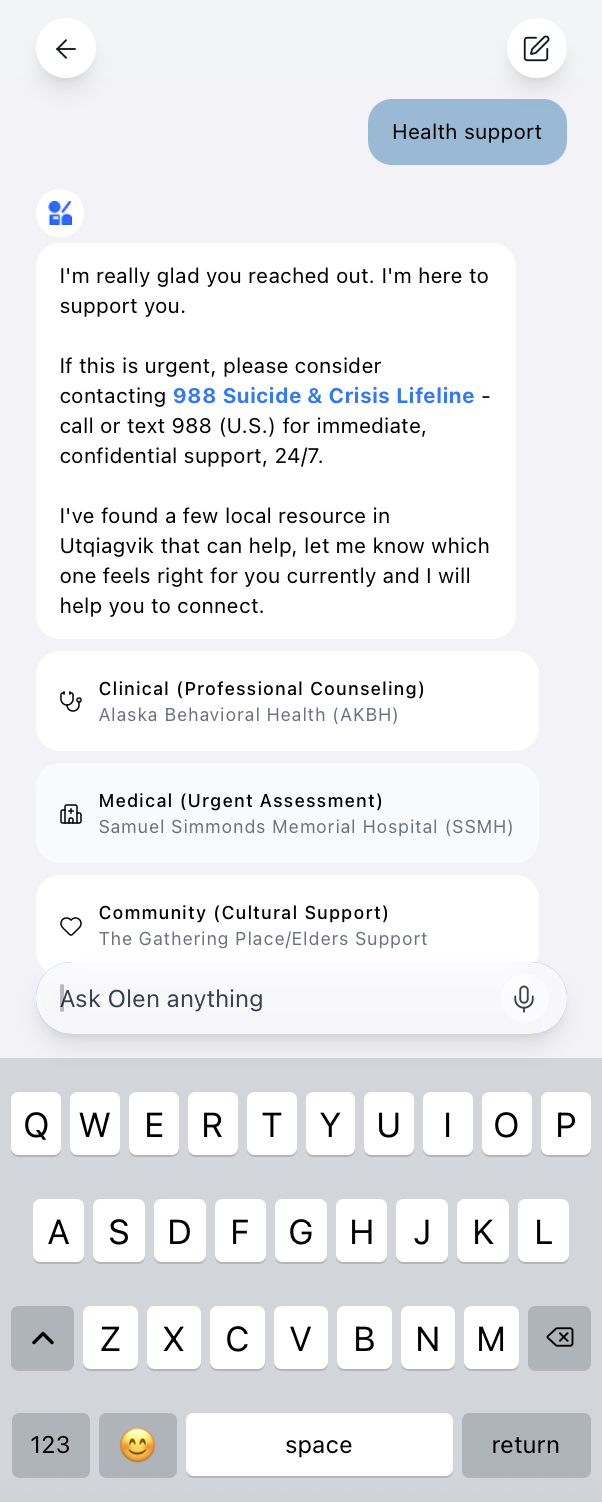
  • AI-orchestrated cross-agency intake — chatbot generates partner-agency referral forms (e.g., Alaska Behavioral Health) with the user's profile data pre-filled, captures a digital signature, and surfaces explicit data-sharing consent before submission
  • Resource directory + aggregated community calendar
  • Admin insight layer — surfaces what users frequently ask, giving administrators demand-signal data without manual log review
  • White-label / re-skinnable — same platform pattern, new brand + content + local knowledge base per deployment
StatusWeb application: pre-launch, near-deployment-ready. Mobile companion app in development.
Engagement shapePre-launch pilot platform — re-skinnable for new Tribal, Native-serving, and community-service deployments. Typical white-label re-deployment runs 6–12 weeks (brand + content + local knowledge base + light partner-agency integrations).
Data sovereigntyDesigned with the data-sovereignty-aware principles described on Federal & Teaming › Responsible Data Use. Client data stays under client ownership; cross-agency data sharing requires explicit user consent (visible in the intake screen below).
Maps to moduleThis single platform spans four module shapes: Olen Hub, Community Calendar / Event Aggregation, AI-assisted document & chatbot, and intake / eligibility workflows. Translatable into a direct Tribal or community-serving engagement, foundation pilot, or federal sub task order at IHS, BIA, Tribal program offices, HHS-funded resource-navigator initiatives, or DOI community-engagement programs.
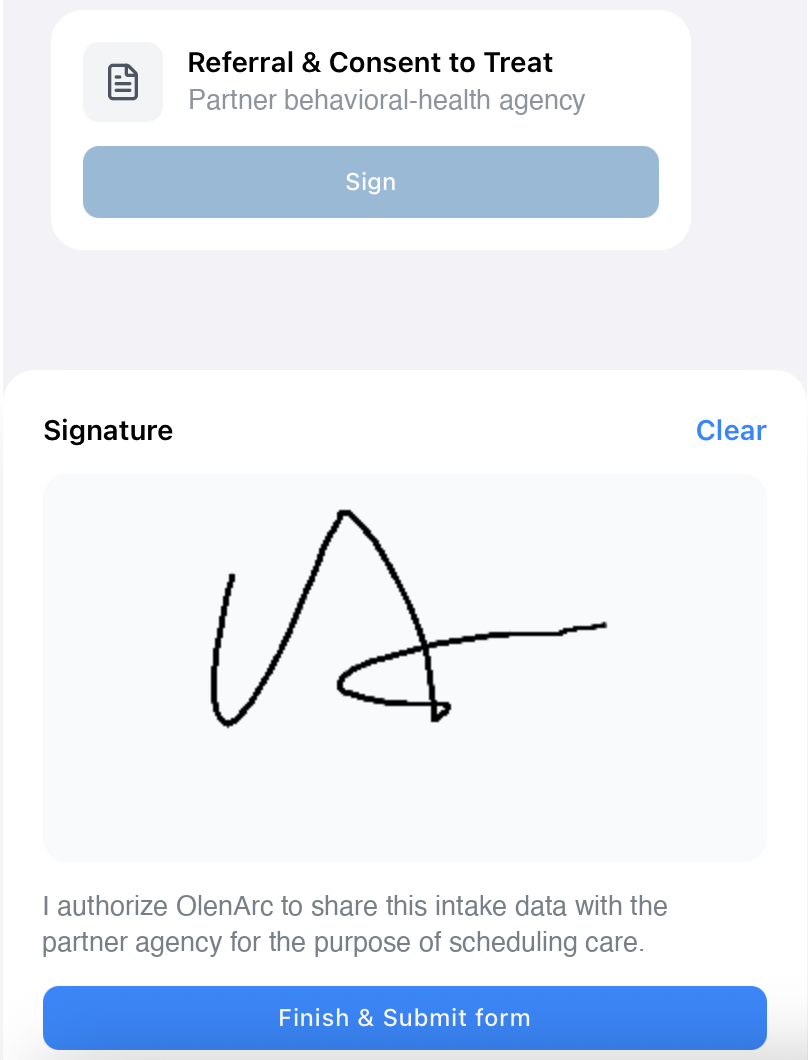
Olen Hub AI-orchestrated intake flow: the chatbot has generated a Referral & Consent to Treat form for Alaska Behavioral Health, basic details pre-filled from the user profile, with a signature pad, an explicit data-sharing authorization line, and a Finish & Submit form button.
Cross-agency intake — AI-orchestrated referral with signature + consent

Demonstration flow. The Alaska Behavioral Health integration shown is illustrative; production cross-agency deployments require partner-agency data-sharing agreements.

Civilian grants · IHS / BIA / HHS · Reference design

AI Document-to-Dashboard — Capture-Phase Reference Design

Capture-phase reference design for AI-assisted document review — adaptable to a Tribal program, state HHS, foundation, or federal sub task order in grant operations.

Status: Reference design, 2025. Not a deployed engagement. Used as a scoping artifact to evidence solution shape for civilian-agency grants modernization — Tribal Health Programs, state HHS programs, foundation grant operations, or federal sub task orders (IHS DGM, BIA / BIE Grants Management, HHS sub-agency reporting). 4-step bounded module: applicant document ingestion → LLM-assisted field extraction → role-based dashboard rollup → AI-drafted narrative review.

Capture-phase reference design · 3–6 week prototype shape · IHS / BIA / HHS-aligned

Reference design AI document review Capture-phase artifact IHS / BIA / HHS
 full case study
Use caseCivilian-agency grant programs — IHS Division of Grants Management, BIA / BIE Grants Management, HHS sub-agency reporting, and foundation grant operations — commonly run on PDF-heavy applications, manual review backlogs, and quarterly reporting cycles that scale poorly. A grants modernization engagement — direct Tribal / foundation, state HHS contract, or federal sub task order — is a recurring civilian-agency pattern.
What the reference design coversA 4-step bounded module scopable as a direct engagement or federal sub task order: (1) applicant document ingestion (PDF / spreadsheet upload from grantee organizations) → (2) LLM-assisted field extraction (structured data + entity recognition tuned to the program’s schema) → (3) dashboard rollup (program-staff view with role-based access) → (4) draft narrative (AI-assisted reporting drafts reviewed and approved by program staff). Inheriting from the production ASCF deployment pattern.
Capabilities usedDocument ingestion · LLM-assisted field extraction · Role-based dashboard generation · AI-drafted narrative review · Section 508 accessibility
Why a prime would lift thisReference design framing means a prime BD lead can copy the module shape and SOW snippet directly into a capture brief without OlenArc claiming deployed past performance the engagement doesn’t have. Matches typical IHS DGM, BIA / BIE, or HHS sub-agency modernization scope.
Engagement shapeCapture-phase reference design — not a deployed engagement. Use it as a scoping starting point for a Tribal, state, foundation, or federal-sub engagement. Early-stage discovery sprints can be sized to fit the $10K federal micro-purchase threshold (FAR 2.101) for partner-prime capture cases. CUI-aware (NIST 800-171 alignment in progress).
Maps to moduleAI Document-to-Dashboard — translatable into a Tribal program engagement, state HHS contract, foundation initiative, or federal sub task order for grant review backlogs, case-management reporting, or document-heavy compliance workflows.

Have a similar scope — RFP, program initiative, or teaming proposal?

Tell us about the program, the scope, and the timeline. We respond within two business days (24h for federal capture or proposal cycles).